




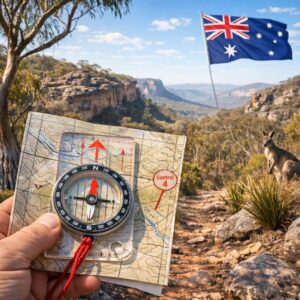
 Compass Basics for Orienteering: Australia’s bushland is vast, varied, and often unforgiving. From open eucalypt forests and dense scrub to rocky escarpments and remote outback plains, knowing how to navigate properly isn’t just a sport skill; it’s a safety essential. Orienteering teaches you how to move confidently through unfamiliar terrain using only a map and a compass, and in the Australian bush, these skills can make all the difference.
This guide covers compass basics for orienteering, with a strong focus on Australian bush conditions, so you can navigate accurately, safely, and like a pro.
Why Compass Skills Matter in the Australian Bush
Unlike many parts of the world, Australian bushland often has:
-
-
- Poor or non-existent mobile reception
- Sparse signage and unmarked trails
- Long distances between landmarks
- Thick scrub that limits visibility
-
GPS devices are useful, but batteries fail, signals drop, and screens break. A compass never runs out of power and works in all weather. For bushwalking, rogaining, orienteering, and even weekend hikes, compass navigation is a critical backup skill, and often the primary one.
Understanding Your Compass (Orienteering Style)
Most Australian orienteers and bushwalkers use a baseplate compass, which is lightweight, accurate, and ideal for map work.
Key Parts of the Compass
-
-
- Baseplate: Clear and flat, used to align with map features and measure distances
- Direction-of-travel arrow: Shows the direction you should walk
- Rotating bezel: Marked from 0 to 360 degrees for setting bearings
- Magnetic needle: The red end points to magnetic north
- Orienting lines and arrow: Used to line up with the map grid lines
-
A simple rule to remember: “Red in the shed”, the red needle sits inside the orienting arrow when you’re on your bearing.
Magnetic Declination in Australia
Magnetic declination is especially important in Australia and varies significantly depending on your location.
-
-
- In Western Australia, declination can be close to zero
- In Eastern Australia, it can be 10–13 degrees east (and slowly changing each year)
-
Most Australian orienteering maps are already adjusted for magnetic north, which means you usually don’t need to manually compensate. However, topographic maps from Geoscience Australia may require adjustment—always check the map legend.
Ignoring declination can send you well off course, especially over long bush legs.
Orienting Your Map in Australian Terrain
Orienting your map correctly helps the landscape “click” into place, an essential skill when bush features are subtle.
How to Orient Your Map
-
-
- Place your map on flat ground or a firm surface
- Lay your compass along the map’s north-south grid lines
- Rotate the map until the magnetic needle lines up with north
-
In Australian bushland, this is particularly useful where tracks fade, creek lines are dry, or vegetation obscures views.
Taking and Following Bearings in the Bush
Bearings are crucial when visibility is limited, common in thick scrub, regrowth forest, or low light.
Taking a Bearing from the Map
-
-
- Place the compass edge between your start point and destination
- Rotate the bezel so the orienting lines align with the map’s north
- Read the bearing at the direction-of-travel arrow
-
Following a Bearing on the Ground
-
-
- Hold the compass flat at chest height
- Turn until the needle aligns with the orienting arrow
- Walk in the direction of the travel arrow
-
In the bush, don’t stare at your compass while walking. Instead, pick a tree, rock, or feature in line with your bearing and walk to it, then repeat.
Australian terrain has its own navigation quirks:
-
-
- Dry creek beds may not always appear obvious on the ground
- Spur and gully systems are common in hilly bushland
- Vegetation density can vary dramatically over short distances
-
Smart orienteers combine compass work with terrain awareness.
Key Techniques
-
-
- Handrails: Fire trails, ridgelines, fence lines, or creeks
- Attack points: Clear features like track junctions or hilltops near your control
- Catching features: Roads, large creeks, or major tracks that stop you from overshooting
-
These techniques are especially useful when bush bashing through scrub or navigating off-track.
Common Compass Mistakes in Australian Conditions
Even experienced navigators can make errors, especially in tough bush environments.
Watch Out For:
-
-
- Holding the compass on a slope: This can tilt the needle and cause inaccuracy
- Metal interference: Avoid power lines, vehicles, or metal gear when taking bearings
- Underestimating distance: Thick scrub slows pace—pace counting is essential
- Overconfidence: The Australian bush can be deceptively challenging
-
Accuracy matters more than speed, particularly in hot or remote areas.
Practising Compass Skills Safely
The best way to improve is through regular practice in low-risk environments.
Practice Ideas
-
-
- Local bush reserves or state forests
- Orienteering club events (very popular across Australia)
- Rogaining events for longer navigation challenges
- Navigation exercises in parks before going remote
-
Always let someone know where you’re going, carry water, and check fire conditions before heading out.
Compass Skills for Bushwalking and Safety
Compass navigation isn’t just for orienteering competitions. In Australia, it’s a key safety skill for:
-
-
- Bushwalking and hiking
- Remote camping trips
- Outdoor education programs
- Emergency and survival situations
-
Many bush search-and-rescue incidents start with simple navigation errors. A compass, used properly, dramatically reduces that risk.
Final Thoughts
Mastering compass basics for orienteering gives you confidence, control, and safety in the Australian bush. By understanding your compass, accounting for magnetic declination, and applying smart bush navigation techniques, you can move through even challenging terrain with accuracy and calm.
In a landscape as vast and wild as Australia’s, navigation isn’t just about finding your way; it’s about respecting the environment and travelling through it responsibly.