




Orienteering with Kids – Turning Maps into Adventures
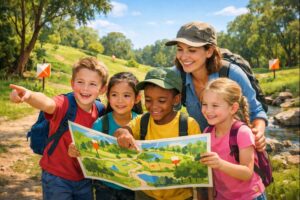 In a world of screens, schedules, and structured activities, it can be surprisingly hard to find something that gets kids moving, thinking, and laughing outdoors all at once. That’s where orienteering with kids comes in. Part treasure hunt, part puzzle, and part outdoor adventure, orienteering turns a simple map into a gateway for exploration, confidence, and family fun.
You don’t need specialist equipment or elite navigation skills to get started. With a map, a sense of curiosity, and a willingness to explore, orienteering can become one of the most rewarding activities you share with children.
What Is Orienteering?
At its core, orienteering is a navigation activity. Participants use a map (and sometimes a compass) to find a series of checkpoints or locations in the correct order. Unlike hiking, where the path is usually marked, orienteering encourages decision-making: Which way should we go? What landmark should we follow? How far is it?
For kids, this transforms a walk into a mission. Trees become markers. Creeks become clues. A park becomes an adventure zone.
Why Orienteering Is Perfect for Kids
Orienteering naturally aligns with how children learn best: through play, movement, and discovery.
It builds confidence.
When kids successfully read a map and find a checkpoint, they experience real achievement. Even small wins, like recognising a symbol or choosing the right path, boost self-esteem.
It develops life skills.
Map reading, spatial awareness, problem-solving, teamwork, and decision-making are all part of orienteering. These skills translate well beyond the bush or park.
It encourages physical activity without pressure.
Because kids are focused on the goal rather than the exercise, they often walk further and stay active longer without complaint.
It reconnects kids with nature.
Orienteering encourages observation: noticing hills, tracks, water features, and vegetation. It helps children feel comfortable and curious outdoors rather than disconnected from it.
Getting Started: Keep It Simple
You don’t need to join a club straight away or tackle complex terrain. Start small and build up.
Choose the right location.
Local parks, school grounds, botanical gardens, and easy bushland reserves are ideal. Look for places with clear paths, obvious landmarks, and safe boundaries.
Use simple maps.
For younger kids, draw your own map. Include playgrounds, trees, benches, paths, and ponds. As kids get older, you can introduce more detailed maps or download beginner orienteering maps from local clubs.
Skip the compass at first.
While compasses are fun, young children can focus on landmarks and directions like “towards the big tree” or “along the path”. Add compass skills later as a new challenge.
Turning Orienteering into an Adventure Game
Kids engage more deeply when orienteering feels like a story rather than a lesson.
Create a treasure hunt.
Hide small items or clues at each checkpoint. The destination might include a treat, a picnic, or a surprise activity.
Add a theme.
Become explorers, pirates, wildlife trackers, or secret agents. A simple narrative turns navigation into imaginative play.
Use challenges instead of competition.
Instead of racing, try challenges like:
-
-
- Find three different leaf shapes along the way
- Spot animal tracks or birds
- Guess distances before checking the map
-
This keeps the focus on learning and fun rather than speed.
Age-Appropriate Orienteering Ideas
Ages 4–6:
-
-
- Very short courses with 3–5 checkpoints
- Large, colourful symbols
- Adult-led navigation with child participation
-
Ages 7–10:
-
-
- Simple decision points (“path or grass?”)
- Let kids lead while adults supervise
- Introduce basic map symbols
-
Ages 11–14:
-
-
- Longer routes with multiple options
- Add compass basics
- Encourage independent thinking and teamwork
-
Every child develops differently, so adjust difficulty based on confidence rather than age alone.
Making It Educational (Without Feeling Like School)
Orienteering naturally supports learning, but it doesn’t need worksheets or lectures.
-
-
- Maths: Estimating distance, counting steps, comparing routes
- Geography: Understanding terrain, symbols, and scale
- Science: Observing ecosystems, weather, and land features
- Literacy: Following instructions, storytelling, and reflection
-
After the activity, ask open questions: What worked? What was tricky? What would you do differently next time?
Safety Tips for Orienteering with Kids
While orienteering is generally very safe, a few guidelines help keep adventures stress-free.
-
-
- Stay within clearly defined boundaries
- Dress for the weather and terrain
- Carry water and snacks
- Teach kids to stop and wait if unsure
- Keep younger children within sight or sound
-
As skills grow, you can gradually allow more independence.
Joining Local Orienteering Communities
Many regions in Australia have family-friendly orienteering clubs that offer beginner events, training days, and school holiday activities. These events often include colour-coded courses designed specifically for kids and beginners.
Joining a club can:
-
-
- Provide professionally made maps
- Introduce kids to like-minded peers
- Offer progression as skills develop
-
It’s also a great way for families to explore new parks and bushland together.
Creating Lasting Memories
Orienteering with kids isn’t about perfect navigation or fast times. It’s about shared experiences, laughing when you take a wrong turn, celebrating when you find a checkpoint, and enjoying the outdoors together.
Over time, kids begin to see maps not as confusing diagrams, but as tools for discovery. They learn to trust their judgement, work as a team, and enjoy the journey as much as the destination.
In a busy world, that’s a powerful gift.